

Bi-fold Sofa Sleeper Mechanism: Complete Product Guide & Practical Selection Handbook
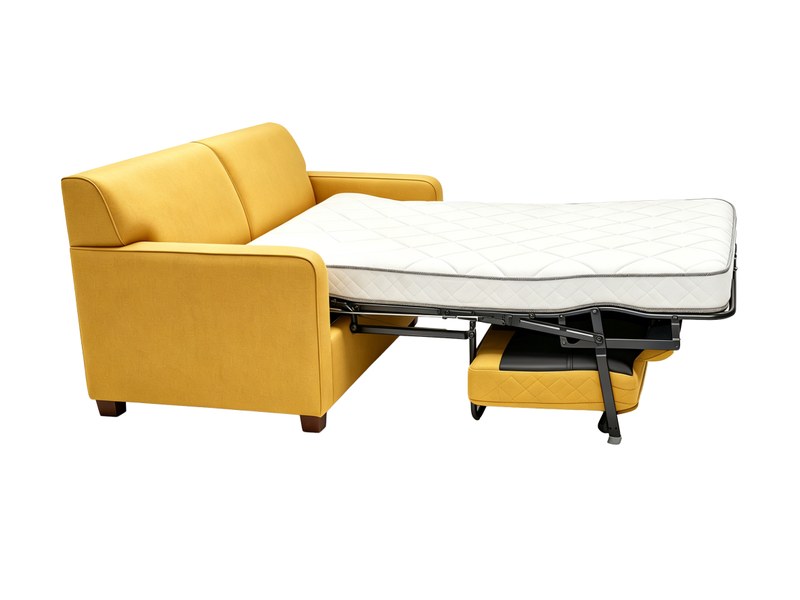
As one of the most widely adopted folding bed solutions in the furniture industry, the bi-fold sofa sleeper mechanism offers a compelling balance of compact storage, independent mattress comfort, and design flexibility. Unlike sliding mechanisms that pull out linearly, the bi-fold system folds transversely in half—storing neatly beneath the seat cushions during the day and unfolding forward to create a flat sleeping surface at night. When closed, the sofa maintains the exact same appearance as a standard stationary sofa, making it an ideal choice for residential, hospitality, and multi-use spaces.
1. How It Works: Mechanism Anatomy
The bi-fold mechanism operates on a two-step logic:
-
Remove seat and back cushions (skip this step if equipped with the optional linked seat function);
-
Grasp the pull strap or crossbar, lift upward and forward, then unfold the frame completely until the floor-supporting legs automatically engage.
Core Structural Components
| Component | Function |
|---|---|
| Main folding frame | Heavy-gauge steel tubing, welded into head section (near backrest) and foot section (extending outward), connected by a heavy-duty piano hinge |
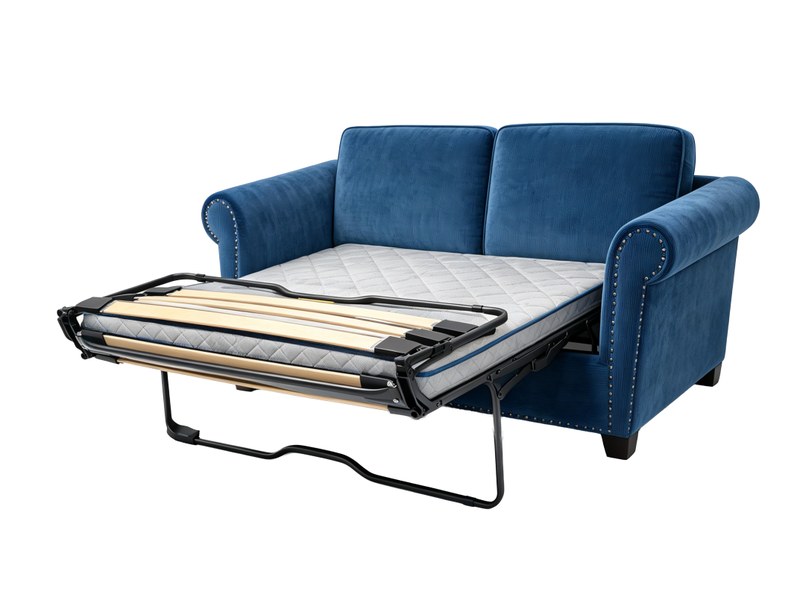
| Mattress support deck | Available in wire mesh, cross-wire + fabric, or flexible wooden slats—supports the independent mattress |
| Anti-tip support legs | Deploy automatically at the foot end when unfolded; prevent forward tipping when weight is applied to the head section |
| Locking mechanism | Engages automatically when fully opened; manual release required for folding |
| Linked seat option | Seat cushion moves forward with the frame via linkage arms, hanging beneath the bed deck—eliminates manual cushion removal |
2. Key Selling Points – What to Look For
2.1 Independent Mattress – The #1 Comfort Factor
The defining advantage of the bi-fold design is that the sleeping surface is completely independent from the sofa upholstery. It accommodates a separate mattress with a standard thickness range of 4 to 6 inches (10–15 cm), available in three primary types:
| Mattress Type | Best For | Pros | Cons |
|---|---|---|---|
| High-density foam | Budget-conscious, occasional use | Affordable, consistent support | Less breathable, may soften over time |
| Memory foam | Side sleepers, pressure relief | Conforms to body contours, excellent comfort | Retains heat (gel-infused versions available) |
| Innerspring | Daily use, high durability | Superior airflow, robust edge support | Heavier, slightly higher cost |
Practical Tip: For daily sleeping, choose a 5–6" innerspring or high-density memory foam mattress. For guest-room occasional use, a 4" foam mattress is sufficient.
2.2 Anti-Tilt Structure – Safety You Can't See
Premium bi-fold mechanisms are equipped with anti-tilt rods and cross-bracing wires installed at the head section (backrest side). This engineered safeguard prevents the entire unit from tipping forward when:
-
A user sits on the edge of the bed;
-
A child climbs or jumps on the sleeping surface;
-
Weight is unevenly distributed near the head end.
Low-cost alternatives often omit this feature—always verify its presence before purchase.
2.3 Mattress Support Deck – Three Configurations Compared
| Support Type | Characteristics | Recommended Use Case |
|---|---|---|
| Cross-wire + fabric | Lightweight, cost-effective; may sag under prolonged heavy use | Occasional guest beds, low-frequency use |
| Metal mesh panel | Even load distribution, no sagging, excellent longevity | Medium-to-high frequency, heavier users |
| Flexible wooden slats | Spring-like resilience, superior breathability, ergonomic | Daily sleep, premium product lines |
Selection Priority: Metal Mesh ≥ Wooden Slats > Cross-wire + Fabric
2.4 Double-Lock & TV Headrest – From "Sleepable" to "Loungeable"
Upgraded bi-fold mechanisms feature an adjustable headrest section that can be angled upward after full deployment. This allows users to:
Read in bed;Watch television comfortably;
Use laptops or mobile devices in a semi-reclined position.
The headrest function is enabled by an additional hinge set with dual locking positions—one for flat sleeping and one for the angled lounge position. Both positions lock securely to prevent unintended collapse.
2.5 Linked Seat Function – Convenience Upgrade
Traditional bi-fold sofas require manual removal and replacement of both seat and back cushions with every open/close cycle—a tedious process that discourages frequent use.
The optional linked seat design solves this through a linkage arm system:
| Action | Linked Seat Behavior |
|---|---|
| Unfolding | Seat cushion automatically moves forward with the frame and hangs beneath the bed deck |
| Folding | Seat cushion returns to its original position automatically |
This feature dramatically improves daily usability, making the bi-fold mechanism viable for high-frequency applications such as studio apartments and multi-functional living rooms.
3. Bi-fold vs. Alternative Mechanisms – Comparison Matrix
| Comparison Dimension | Bi-fold (2-Fold) | Tri-fold (3-Fold) | Sliding (Pull-Out) |
|---|---|---|---|
| Stored thickness | Thin—fits compact sofa profiles | Thinner, but more seams on sleep surface | Thicker—requires taller seat box |
| Operation steps | 2 steps (or 0 with linked seat) | 2–3 steps | 1 step (pull and go) |
| Independent mattress | ✅ Yes | ✅ Yes | ❌ Most rely on sofa cushions |
| Cost level | Moderate | Moderate–Low | High |
| Floor space required | Forward extension (needs clearance) | Forward extension (slightly shorter) | Forward extension with longer track |
| Recommended frequency | Medium–high (with linked seat) | Low (occasional guests) | Daily / high-frequency use |
| Ease of use (elderly/children) | Moderate (requires lifting strength) | Moderate | Easy (one-motion pull) |
4. Installation & Maintenance Best Practices
Installation Guidelines
Symmetry is critical: The mechanism must be centered and squared within the sofa frame. Even a 2–3 mm offset can cause binding during unfolding or an uneven sleep surface.Support legs: Verify that legs fully retract inside the sofa base when closed and do not drag on the floor during operation.
Clearance check: Allow sufficient floor clearance (minimum 2" / 50 mm) beneath the sofa for leg deployment.
Maintenance Schedule – Every 6 Months
| Task | Frequency | Recommended Product / Action |
|---|---|---|
| Lubricate hinges & locks | Biannual | Apply dry silicone spray—avoid petroleum-based oils (they attract dust and gum up) |
| Tighten all fasteners | Biannual | Check all bolts, screws, and rivets; re-torque as needed |
| Inspect support deck | Annual | For wire mesh: check for broken or loose wires; for slats: verify end caps are intact |
| Clean tracks & joints | As needed | Wipe with a dry cloth to remove dust and debris |
⚠️ Critical Warning: Never use WD-40 or standard machine oil on mechanism joints. These products attract airborne dust, forming an abrasive paste that accelerates wear within weeks.